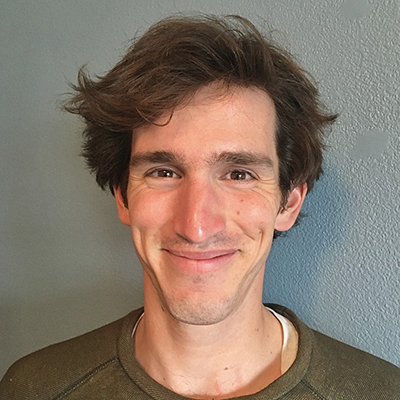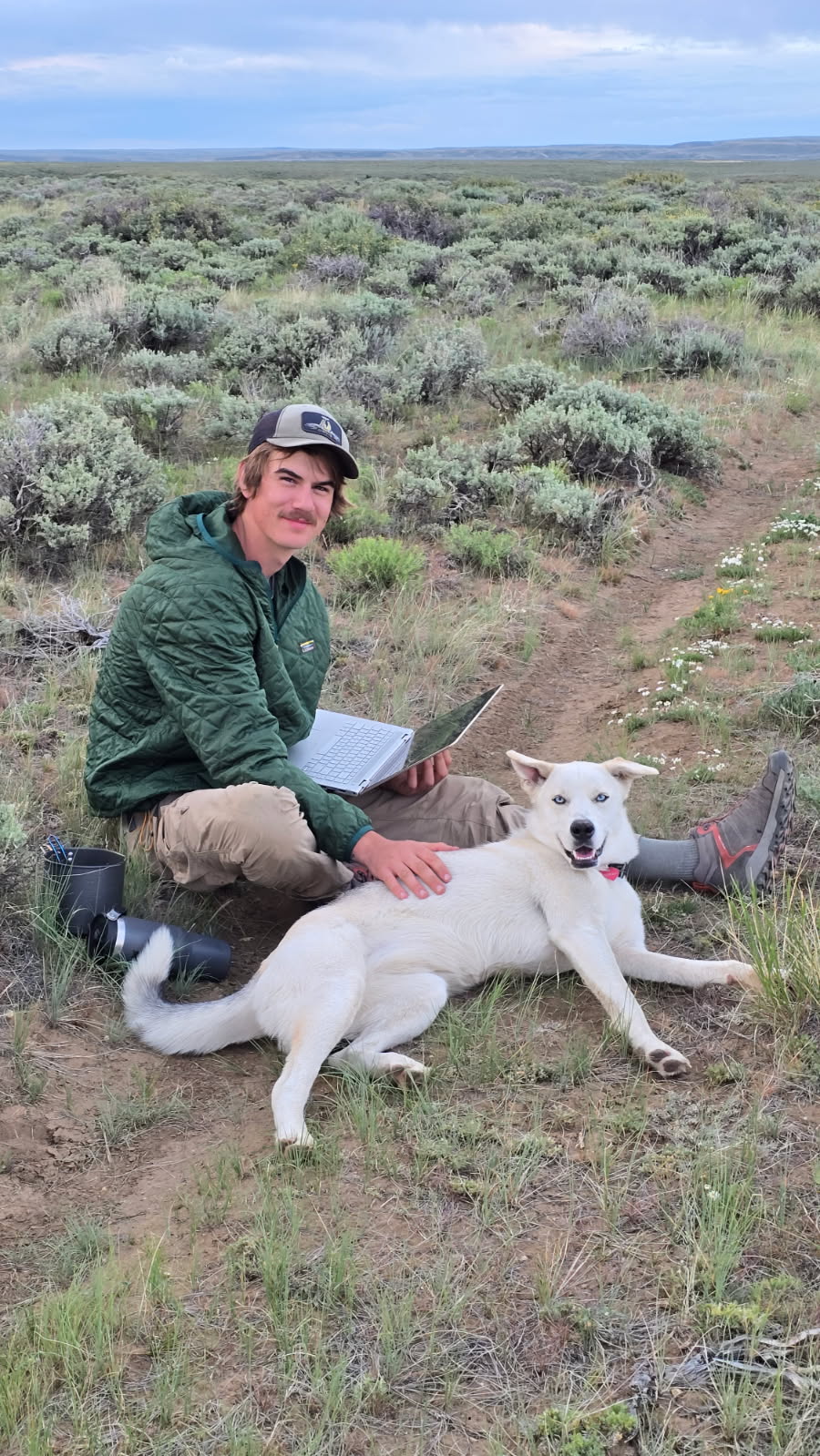

Zachery Holmes - "Competitive Eavesdropping: Are frugivorous competitors cueing into the soundscape to increase frugivory and seed dispersal success?"
"The Biodiversity Institute funds will allow me to purchase the necessary equipment to understand what types of information is available for these birds, and how that information is used to increase frugivory and subsequent seed dispersal. This can have long-lasting impacts on our understanding of the causal drivers of successful frugivory events. Given that many native fruiting plants depend on successful dispersal events to avoid density-dependent mortality and increase gene flow across the landscape, understanding the drivers of successful frugivory is important for management plans to save the species that are still present in this endangered system."
Zachery Holmes
Ph.D. Student
2026 Recipient of the Biodiversity Institute Graduate Student Excellence Grant
Department of Zoology and Physiology
Graduate Advisor: Patrick Kelley
Background:
Background and Rationale: Seed dispersal is one of the most important mutualistic relationships and ecosystem services, and yet one of the most threatened system-level processes globally (Fell et al. 2023). Effective seed dispersal drives biodiversity levels and system stability by increasing species richness, expanding species distributions, providing mechanisms for gene flow, increasing vegetative structure heterogeneity, and encouraging regeneration post disturbance (Fricke et al. 2025). A condition for seed dispersal is successful consumption of fruit and retention of their seeds (Schupp et al. 2010). Therefore, we must also thoroughly understand the mechanisms that drive frugivory which have causal effects on seed dispersal, biodiversity, and system stability (Nogales et al. 2024).
A major selective pressure acting on frugivorous species is the need to find consistent and reliable food resources (Miller et al. 2017). The result of this pressure drives species behavior which directly impacts individual and population fitness. In response to these pressures, behavioral adaptations have evolved that take advantage of available information which increases foraging success (Jones and Sieving 2019). In birds, one behavioral adaptation is the ability to detect and respond to auditory cues of resource profitability (Pollock et al. 2017). Intentional auditory cues that conspecifics and heterospecifics display that relay specific information are known as auditory signals (Elie et al. 2019). Across temperate and tropical systems, field experiments have shown that bird species have learned to eavesdrop on these auditory signals to increase fitness outcomes (Pollock et al. 2017) including for foraging success (Sridhar and Shanker 2014). The probability of foraging-related eavesdropping dramatically increases when avian species form conspecific and mixed-species foraging flocks as potentially advantageous foraging strategies (Jones et al. 2020). While mixed-species foraging flocks often partition themselves across foraging niches (Beauchamp and Mangini 2024), conspecific foraging flocks are predicted to be direct competitors for food resources (Gu et al. 2017). Despite this apparent direct competition, conspecific foraging flocks in frugivorous birds do form and have apparent positively correlated fitness outcomes (Wilcox and Tarwater 2025).
While many examples exist for auditory eavesdropping in insectivorous bird species (Jones and Sieving 2019), testing this hypothesis in a frugivorous community is largely understudied (but see Gu et al. 2017, MacDonald et al. 2019). While fruit resources are spatially stationary, they are temporally variable and competition for time sensitive resources maintains selective pressure. We do not yet understand how fruit and frugivore functional traits in the context of frugivorous foraging flocks influence the bird’s choice to signal, and the information within each signal. However, determining the probability of signaling and information reception can increase our understanding of the mechanistic underpinnings of successful frugivory and seed dispersal events.
In O’ahu, Hawai’i, the avian frugivorous community consists entirely of non-native introduced species. These species have filled an exposed foraging niche due to the extinction of native frugivorous birds (Vizentin-Bugoni et al. 2019). Previous work in this system has demonstrated that focal frugivorous species form conspecific and/or heterospecific foraging flocks despite evolutionary novelty (Wilcox and Tarwater 2025). Furthermore, work has shown that the fruiting neighborhood can influence the total number of successful frugivory (Hopson et al. 2020). Together these two lines of preliminary evidence show support for a potential relationship between frugivore signaling and frugivory success. However, the information that frugivorous birds are cueing into remains unclear. Understanding the mechanisms that increase frugivory rates, such as auditory signals, could shed light on seed dispersal potential and drivers of biodiversity.
Objective of the Project: This project aims to understand the causal mechanisms that drive frugivory and seed dispersal in the imperiled O’ahu mesic wet forest system, which is a critical mutualistic relationship that maintains and restores biodiversity. In this causal framework I will be able to infer direct mechanisms of frugivory, and not simply correlative predictions. In the face of continuous pressure from human-induced impacts and invasive species, understanding the mechanisms that influence successful seed dispersal is crucial for conservation strategies.
Share This Page
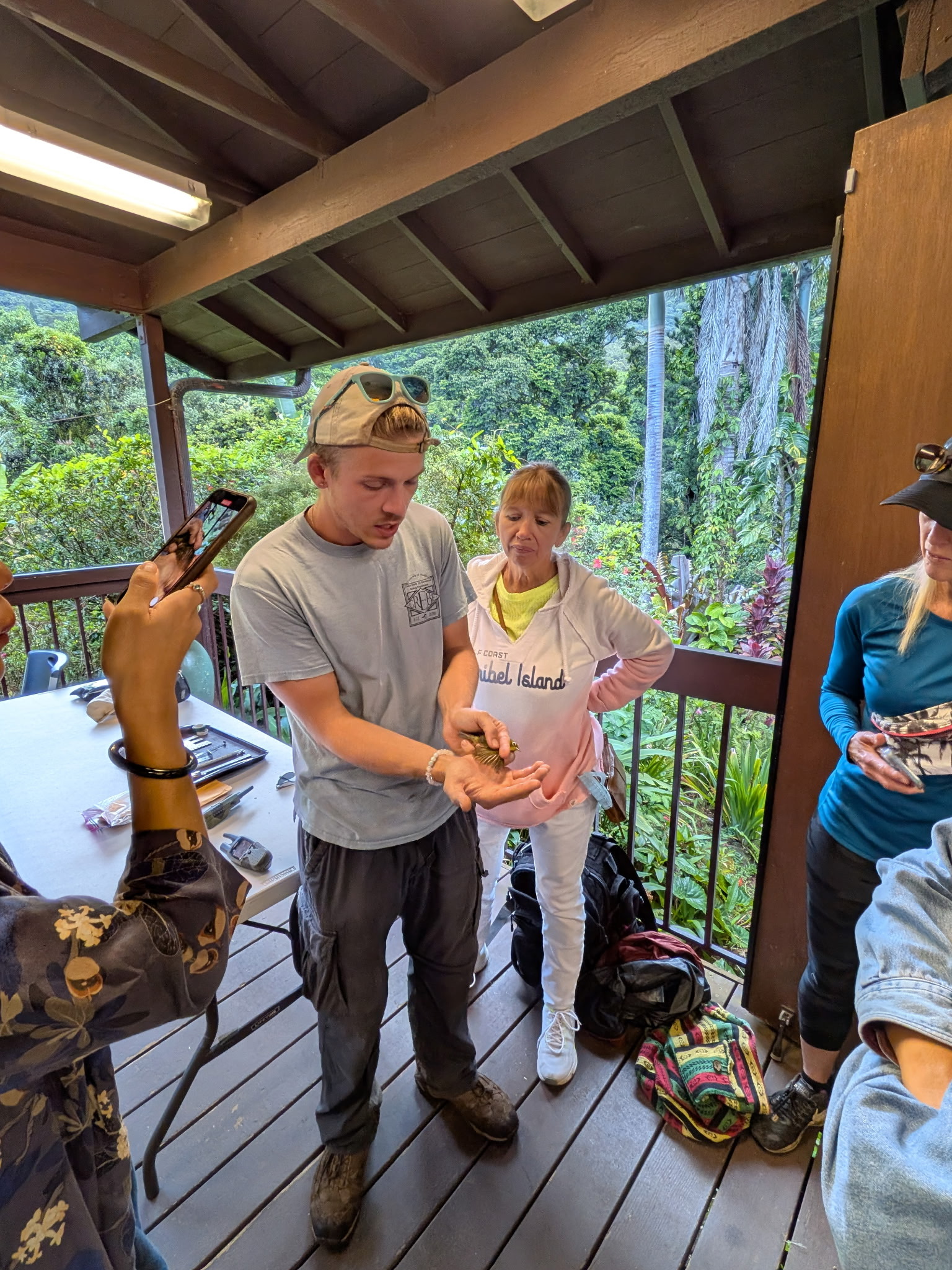
Zach Holmes teaching proper bird handling and banding techniques during a community outreach event in partnership with the Hawai’i VINE Project and Lyon Arboretum.
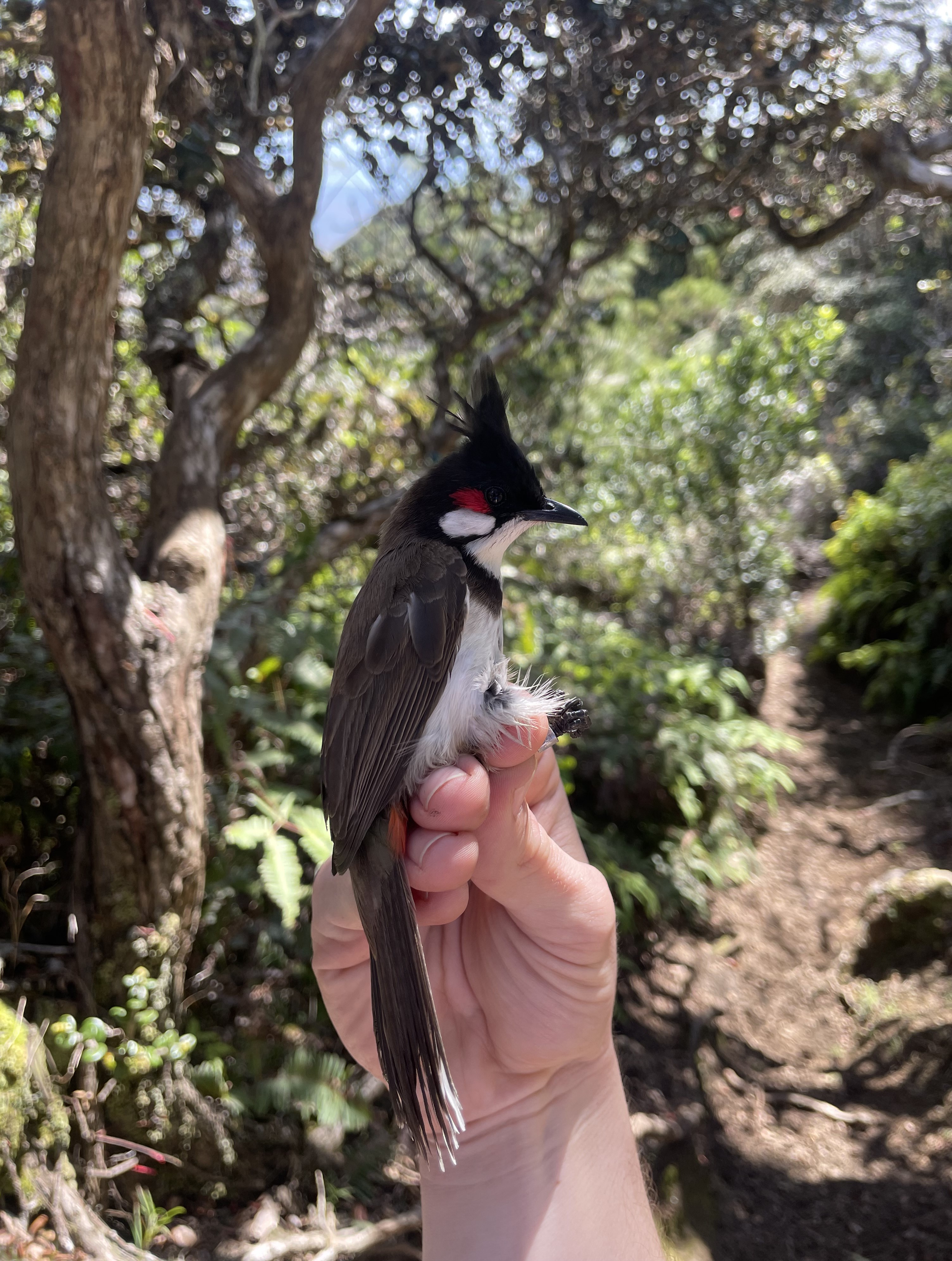
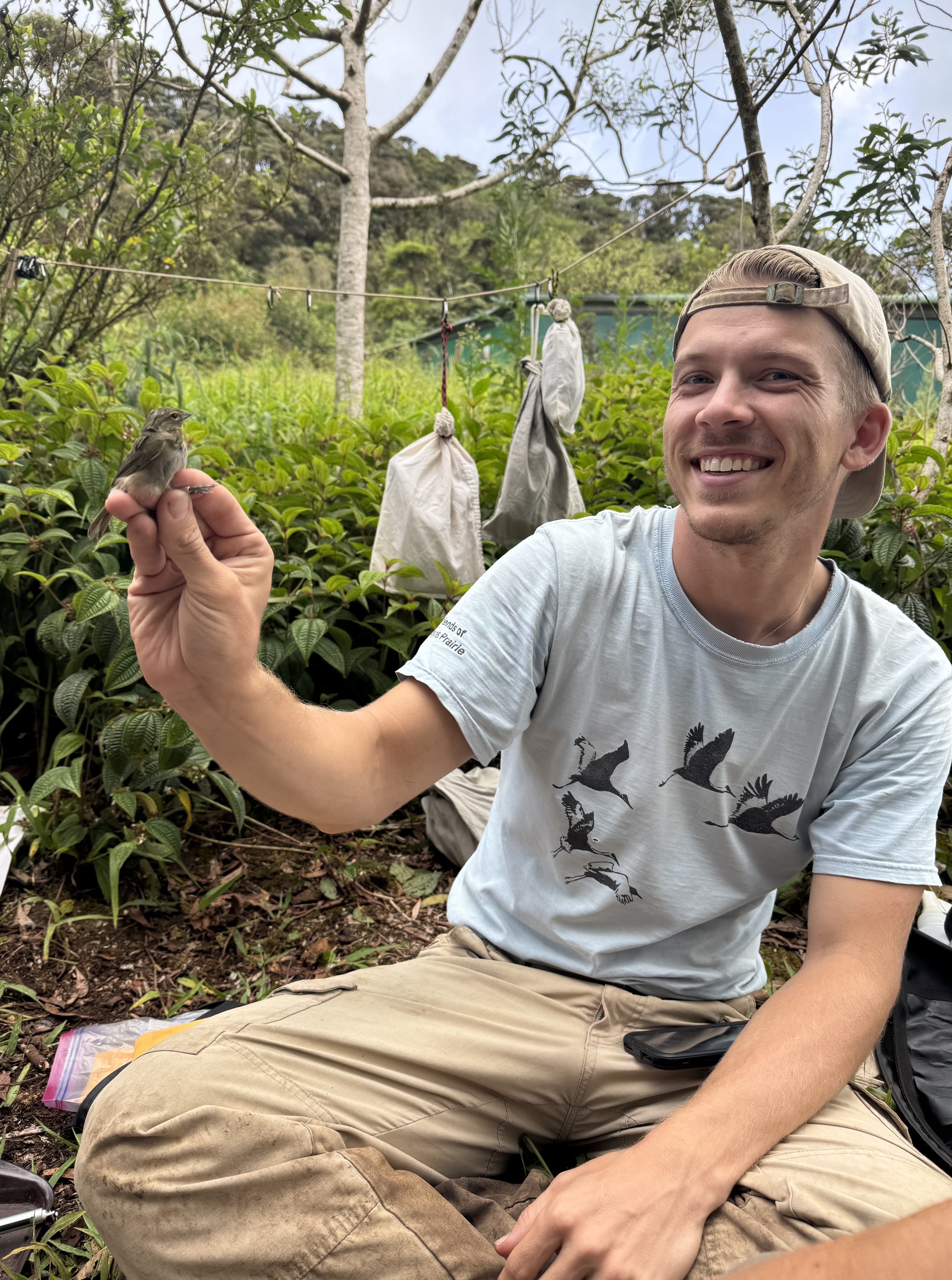
A Red-whiskered Bulbul (Pycnonotus jocosus) banded in collaboration with the Hawai’i VINE Project during a banding session within one of our plots. Red-whiskered Bulbuls were introduced to O’ahu in the 1980s and are now one of the primary seed dispersers in this novel network.
Research Highlights